Alpha Singulariity

Notícias

  • All
  • Notícias
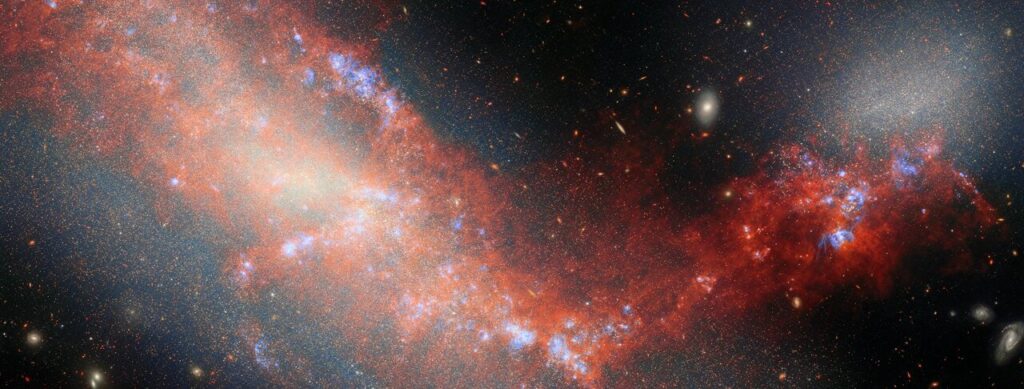
For this new ESA/Webb Picture of the Month, the NASA/ESA/CSA James Webb Space Telescope has spied a pair of dwarf galaxies engaged in a gravitational dance. These two galaxies are named NGC 4490 and NGC 4485, and they’re located about 24 million light-years away in the constellation Canes Venatici (The Hunting Dogs). Aside from the Milky Way’s own dwarf companions (the Large and Small Magellanic Clouds), this is the closest known interacting dwarf-dwarf system where astronomers have directly observed both a gas bridge and resolved stellar populations. Together NGC 4490 and NGC 4485 form the system Arp 269, which is featured in the Atlas of Peculiar Galaxies. At such a close distance (and with Webb’s impressive ability to peer through dusty cosmic clouds) these galaxies allow astronomers to witness up close the kinds of galaxy interactions that were common billions of years ago. Dwarf galaxies likely share many similarities with young galaxies in the early Universe: they are much less massive than galaxies like the Milky Way, they typically have small amounts of metals (what astronomers call elements heavier than helium), and they contain a lot of gas and relatively few stars. When nearby dwarf galaxies collide, merge, or steal gas from one another, it can tell us how galaxies billions of years ago might have grown and evolved.  The nearby dwarf galaxies NGC 4490 and NGC 4485 form an intriguing pair. Nearly three decades ago, astronomers discovered a wispy bridge of gas connecting the two galaxies, showing that they have interacted in the past. Despite many studies with powerful telescopes like the NASA/ESA Hubble Space Telescope, the history between NGC4490 and NGC 4485 has remained mysterious. Recently, Webb observed this curious galactic pair as part of the Feedback in Emerging extrAgalactic Star clusTers (FEAST) programme (#1783; PI: A. Adamo). The FEAST programme used Webb’s sensitive infrared eyes to reveal the formation of new stars in different types

dezembro 27, 2025

Nessa foto, a NGC 4490 está do lado esquerdo (maior e mais estruturada), e a NGC 4485 aparece como um brilho branco no canto superior direito. A ponte vermelha brilhante conecta as duas, cheia de poeira e gás. Pontos azuis mostram onde novas estrelas estão nascendo. Imagine duas galáxias pequenas, como se estivessem dançando juntas no espaço, puxando uma à outra pela força da gravidade. É exatamente isso...

12
Next